Odds & Ends
 Parts & Labor Expo
 Biltwell 100
 People's Champ
 Born-Free
 NorthWest Motofest
 Gypsy Run
 Kernville Kampout
 WTF Blog
 P&L Magazine
 P&L Podcast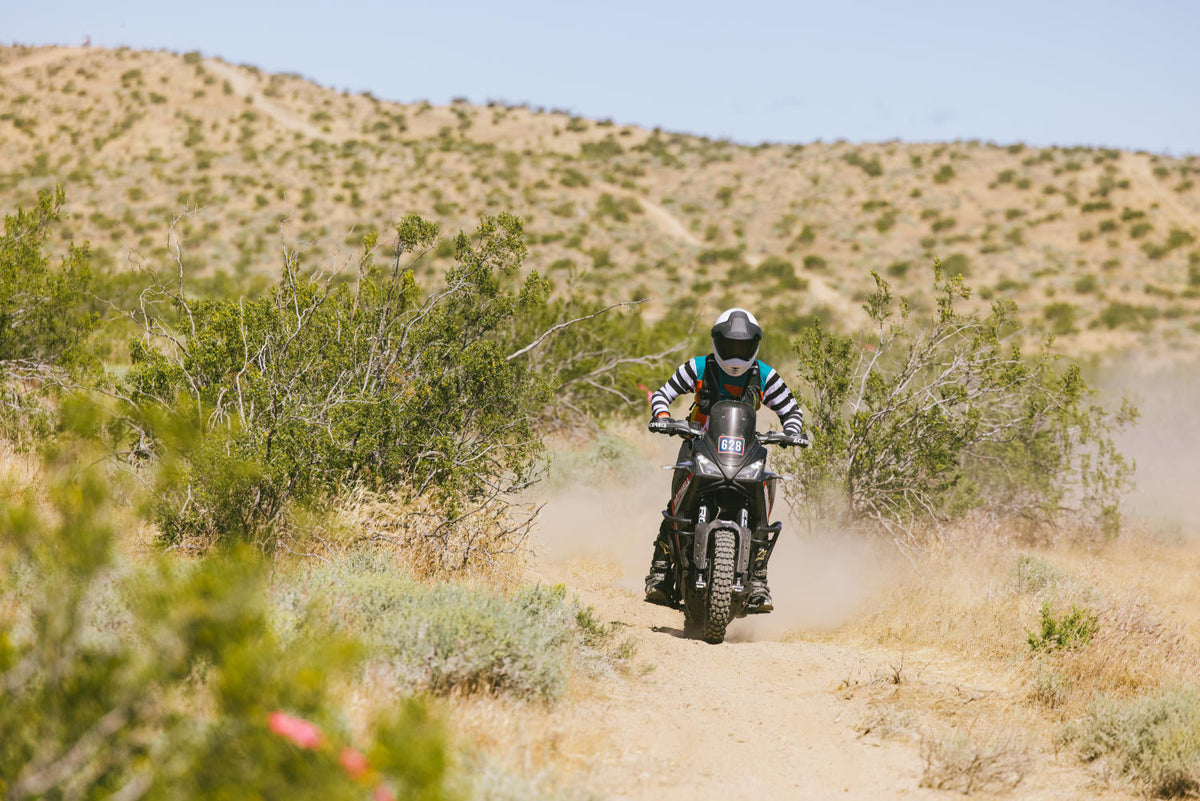
Racing a Budget ADV Bike at the Biltwell 100
Story by Erik Westergaard / Photos by Geoff Kowalchuk
 Not everything goes to plan, but to be completely honest, the plan might have been flawed from the start. As the product manager at Biltwell, it’s one of my job responsibilities to dream big. By doing so, however, sometimes I take machines out of their comfort zones. Whether it was building a 60mph electric pit bike way back in 2005, transforming a Dodge minivan into a capable off-road rig, or helping turn a Harley Sportster 883 into a desert racer that finished the grueling NORRA 1000, I love a good challenge.
 With this year’s Biltwell 100 around the corner, my brain kicked in. How would a budget-conscious, $7,000 Moto Morini X-Cape 650 fare in a proper desert race? Held in Ridgecrest, California, the Biltwell 100 is an off-road desert race designed to be totally inclusive—you’ll see everything from vintage builds and modern dirt bikes to heavy Harleys, minibikes and even large ADV bikes tearing through the Mojave. The ethos is simple: Good Times, Not Lap Times.
Proof of Concept
Any bike can be made capable if you throw enough custom fabrication and money at it. For this project, I set a strict rule: only utilize readily available, off-the-shelf parts and services. I wanted this build to be easy for anyone who owns an X-Cape to replicate for serious off-road action beyond its intended use.
At 57 years old but with semi-pro experience in ATV racing as a teenager in the ‘80s, I fall solidly into the “mid-pack goon” among experts in my age class. I have a 2006 Honda CRF450X, but I typically only manage to ride it a couple of times a year. Training for this event? Non-existent. Testing? Even less.
In fact, before race day, I had never taken the Moto Morini more than 250 yards into the dirt. I was still mounting off-road tires and adjusting ergonomics two days before loading up the truck. I spent two hours in our campground in Ridgecrest the night before the race finishing up a few outstanding items, finally sneaking in a single practice lap on the recently marked course at sundown the night before the event.


Prepping the Machine
The stock X-Cape 650 is a great commuter bike with positive reviews for its handling on fire roads and light off-roading, but the stock rear suspension is notoriously soft. While perfectly adequate for my ride to work over SoCal’s Ortega Highway, I knew the stock suspension would need a major upgrade to survive the Mojave.
I called up retired pro MX racer Weston Peick at RG3 Suspension in Idaho. I was told by Scott at Moto Morini that he had been doing some internal testing on springs and valving for this exact bike. I told Weston that I’m 6'0" and 200 pounds, and we came up with a plan. We ordered an Andreani USA kit featuring Misano EVO fork cartridges with 8.8 springs and an Ohlins rear shock with a 180# spring. The whole package was shipped to Weston at RG3 for the internal upgrades.
To wake up the 650cc twin, I added a Rapid Bike tuner. It piggybacks directly onto the stock wiring harness, and best of all, it doesn't void Moto Morini’s excellent 3-year unlimited mileage warranty. I chose a full Exan exhaust from Italy because I thought the high-mount design might keep the titanium can tucked up and away from potential trail damage. (Be prepared for a 40% import duty fee on imported steel into the USA if you go this route!).
Because of the new Exan headers, the upgraded factory skid plate wasn’t going to work, so I worked with Cody at Moto Morini and instead went for an SW Motech skid plate, which offered the necessary clearance for the pipe, though I had some lingering concerns about how it mounted directly to the engine’s oil pan… more on that later.
For rubber, I went with Motoz because I run them on my 450X and love them. Brian at Pacific Powersports in Temecula is the source for those. To prevent race-ending flats, he installed a Nitro Mousse into the 19-inch front tire, but they don't make a mousse for a 17-inch adventure rear, so I used an ultra-heavy-duty tube.
Finally, I tossed the stock footpegs for a set of oversized Biltwell Punisher pegs for maximum boot traction, and swapped the stock bars for Pro Taper Evo Adventure High bars. At a 174mm rise, they were exactly what my back needed. Amazingly, all the stock cables and wiring fit perfectly with a minor re-route of the clutch cable and front brake line behind the top triple clamp. With the risers pushed to the forward-most position, I could stand up comfortably nearly the entire race.

Dropping the Clutch
I signed up for the ADV Lite - Expert class, which meant four laps around the brutal 25-mile course. One hundred miles of deep Mojave sand, rocks, technical hills, and relentless whoops. Mine was the first class off the line Saturday morning. Although I'm not afraid of a fast start, I massively overestimated the traction of the rear tire on the sand-coated hard-pack dirt. When the green flag dropped, I had the timing right, but the bike instantly shot sideways. I spent the next three seconds in a violent wrestling match just to get the machine pointed straight again. I'd like to formally apologize to the guy on my left. That moment was a swift reminder to turn off “race-mode” in my brain. I was here to test a concept and have fun.
“It is infinitely more fun to ride a slow bike fast than it is to ride a fast bike slow.”
The first lap of a desert race on an adventure bike that you’ve never properly ridden in the dirt is a wild experience. I wasn’t worried about power—the Rapid Bike tuner and Exan pipe completely woke the motor up, giving it a playful, snappy grunt. Not that it was even necessary. My real anxiety was the suspension. Bashing a 500-pound adventure bike through a deeply whooped-out course with less than seven inches of travel should have been worrying. But as I dialed back my pace and focused on just finding a rhythm, a funny thing happened: the bike was incredibly fun.
The RG3-tuned suspension did exactly what it was supposed to do. The thoughts of possibly regretting my life choices quickly vanished, and I couldn't help but smile at how well the bike was absorbing the terrain. I did get a little cocky around mile 12 on a high-speed section near the railroad tracks. Pushing 70 mph through some shallow bumps, the bike started to give me a tank-slapper and I reminded myself of the bike I was on, relaxed off the throttle, and the chassis settled down instantly. Near crisis, averted.

Overconfidence and Engine Oil
The problem with suspension that works too well is that your confidence grows faster than your skill. By Lap 2, I was charging into sandy riverbeds like I was on my CRF450X. When it came time to slow down and pivot the heavy adventure bike in deep sand, physics caught up with me. I found myself lifting the heavy bike out of the sand more than once. That was a “me” problem, not a bike problem.
At one point, I got out of shape and clipped the edge of a massive whoop going into a sandy left turn and snapped the front fender mount off the lower fork leg. The right side held strong but for the rest of the race, every single bump was accompanied by an awful, metallic CLACK. It sounded terminal, but I stopped to check it out and the bike handled fine, and as long as the fender stayed on it kept the front brake lines out of the tire, so I kept going.

I skipped pitting the end of lap 2 because my fuel and hydration pack were fine. I just gave an enthusiastic wave to my lovely pit boss, Sarah, as I blasted down pit row and headed out for Lap 3.
I was settled into a great pace, comfortably past the halfway mark, when the desert decided it was time to take its tax at mile 9 of lap 3. I came over a rise and encountered a rescue Mule pulling a disabled bike off the course. To give them space, I slowed down into first gear and detoured around a bush and through a shallow, dry grassy area. Hidden in that grass were a bunch of boulders. My front tire clipped a rock, and the bike flopped onto its side. I dropped a few choice words into my helmet—mostly because I was getting tired and just didn't want to pick the heavy machine up again. I wrestled the bike back onto its tires, but as I went to swing my leg over the seat, I saw the end of my race day.
Two steady streams of engine oil were pouring out of the side of the bike, returning that golden amber back to the Mojave earth.
It wasn't a rock puncture through the engine. The issue was the skidplate, which mounts directly into the cast aluminum bungs on the factory oil pan. When it hit one of the boulders, the impact transferred directly through the skid plate and snapped the cast aluminum bungs clean off the oil pan. Just like that, my day was done at mile 59.

The Verdict
Was this plan flawed from the start? No. It is a very solid bike that I put through some different paces, this is the stuff good times are made of. Am I disappointed in the result? A little bit. But was I happy with how the Moto Morini X-Cape 650 performed?

Absolutely.
We took a budget-friendly adventure bike completely out of its comfort zone and proved that with a few smart, off-the-shelf modifications, it can handle a legitimate desert race at a mid-pack pace and more importantly, it is ridiculously fun to ride. The motor ran flawlessly, the ergonomics were perfect for standing up all day, and the RG3-valved Andreani and Ohlins suspension performed miracles in the whoops.
Will I attempt the Biltwell 100 on this bike again next year? You bet.
For 2027, the plan is simple: add a steering stabilizer to fix the high-speed head shake and help avoid any catastrophic tank-slappers; install longer handlebar riser bolts with lock nuts under the top triple clamp; and engineer an improved, isolated skid-plate mounting system that doesn't rely so much on the bungs of the cast aluminum oil pan.
Oh… and a lot more riding.
—Westy